Backend
How it works
- The Controller publishes updates every minute to an Amazon SNS topic. This has already been created for you.
- You will create a Lambda function in your account that is invoked whenever notifications arrive on this topic. This function will store the message in DynamoDB and forward the message to IoT Core.
- Finally, you will update the front-end application configuration to listen to this IoT endpoint, and republish the frontend.
More information on the services introduced in this section:
The Real-Time Serverless Backend
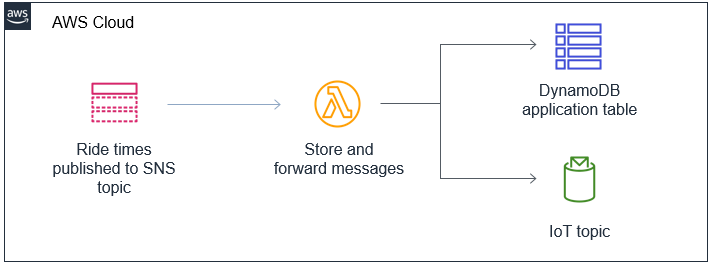
- The Flow & Traffic Controller is already deployed and publishes updates to an SNS topic.
- The Lambda function receives new messages as an event payload and parses out the message. It then stores the message in a DynamoDB table and forwards to an IoT topic.
- The DynamoDB table only stores the last message. This initial state is needed when the front-end application is first loaded.
- The IoT topic is the conduit from the serverless backend to the front-end application. Any messages posted here will be received by the front-end.
Set up environment variables
Run the following commands in the Cloud9 terminal to set environment variables used in this workshop:
AWS_REGION=$(curl -s http://169.254.169.254/latest/meta-data/placement/availability-zone | sed 's/\(.*\)[a-z]/\1/')
accountId=$(curl -s http://169.254.169.254/latest/dynamic/instance-identity/document | jq -r .accountId)
s3_deploy_bucket="theme-park-sam-deploys-${accountId}"
Environment variables are not stored in the terminal. Any time you close Cloud9 or open a new terminal, you will need to rerun these commands to set environment variables. This section is provided in each module.
Create the Lambda function
Step-by-step instructions
-
Go to the Lambda console - from the AWS Management Console, select Services then select Lambda under Compute. Make sure your region is correct. You will see some Lambda functions that SAM has already deployed.
-
Select Create function:
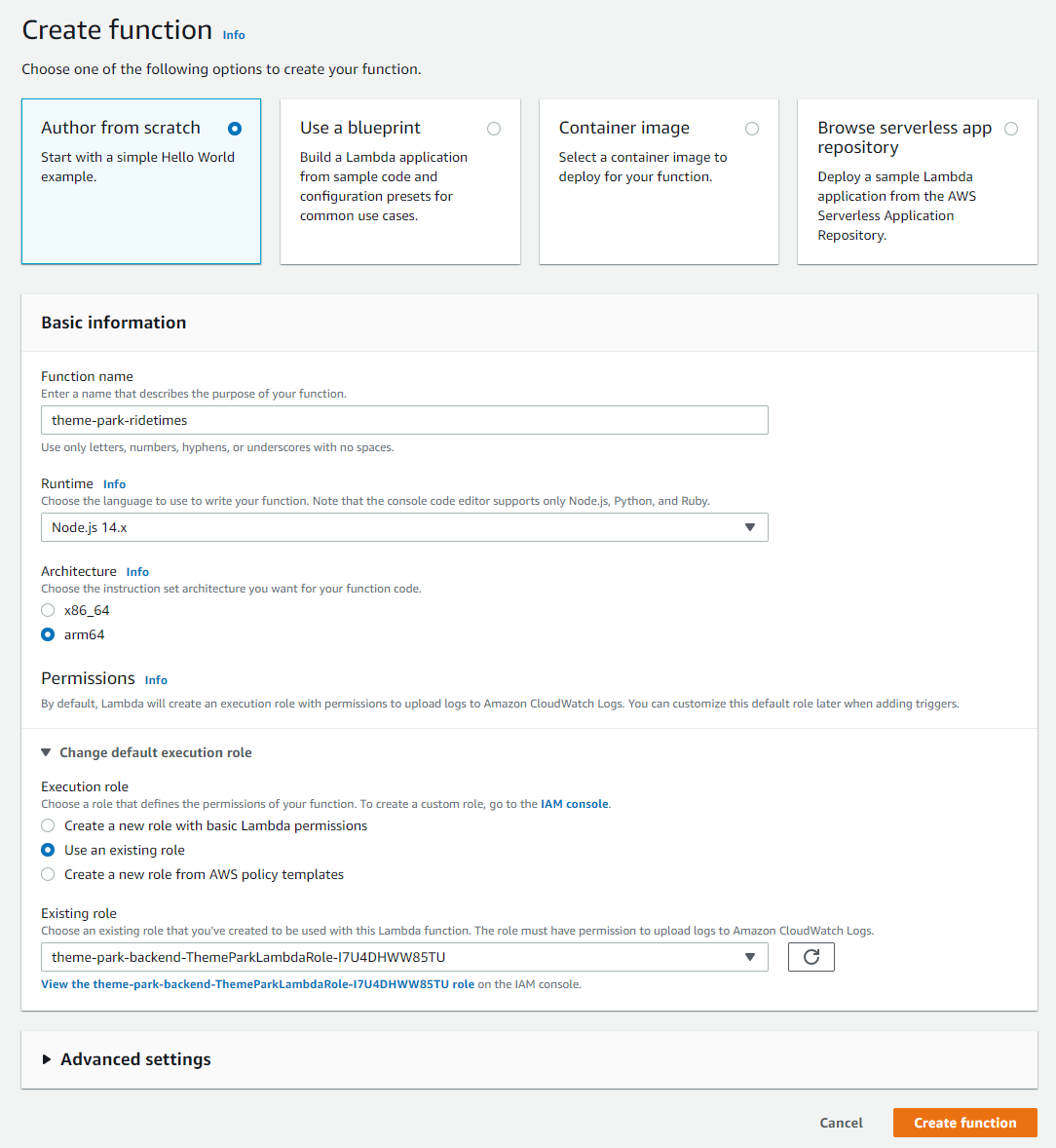
- Ensure Author from scratch is selected.
- Enter
theme-park-ridetimesfor Function name. - Ensure
Node.js 14.xis selected under Runtime. - For Architecture, choose
arm64.
Lambda functions that use arm64 architecture (AWS Graviton2 processor) can achieve significantly better better price and performance than the equivalent function running on x86_64 architecture. For more information, read this documentation page.
- Open the Change default execution role section:
- Select the Use an existing role radio button.
- Click the Existing role drop-down, and enter ThemeParkLambdaRole until the filter matches a single available role beginning with theme-park-backend-ThemeParkLambdaRole*.
- Select this role.
- Select Create function.
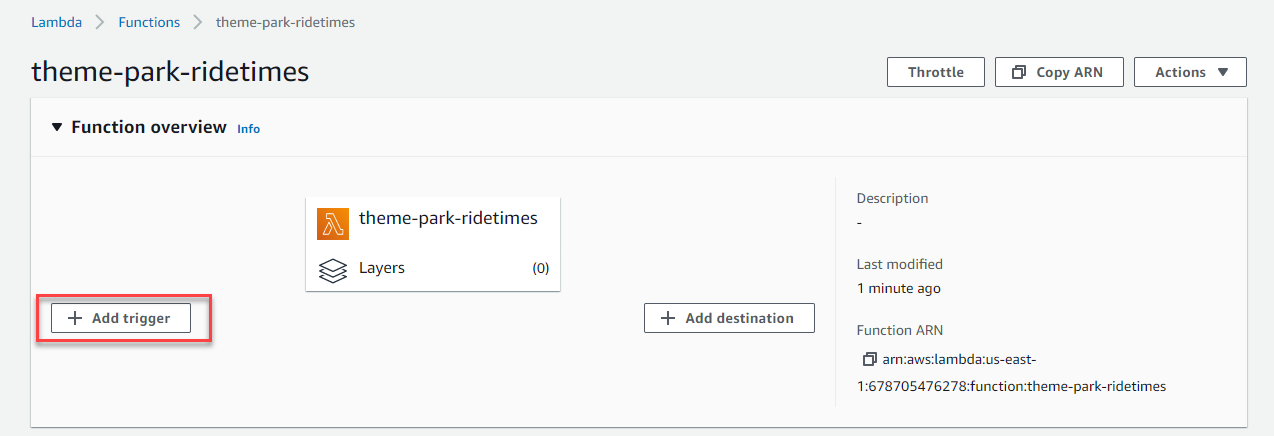
- Expand the Function overview section. Select + Add trigger.
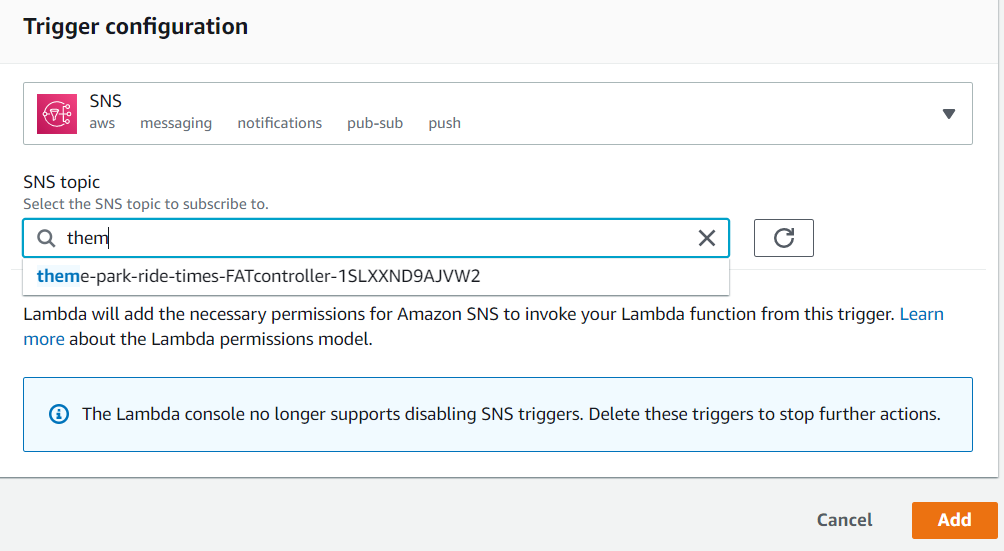
- In the Trigger configuration dropdown, choose SNS. In the SNS topic selector, select the SNS topic starting with
theme-park-ride-times:
-
Choose Add.
-
Back in the function view, select the Code tab. This opens the code source panel below.
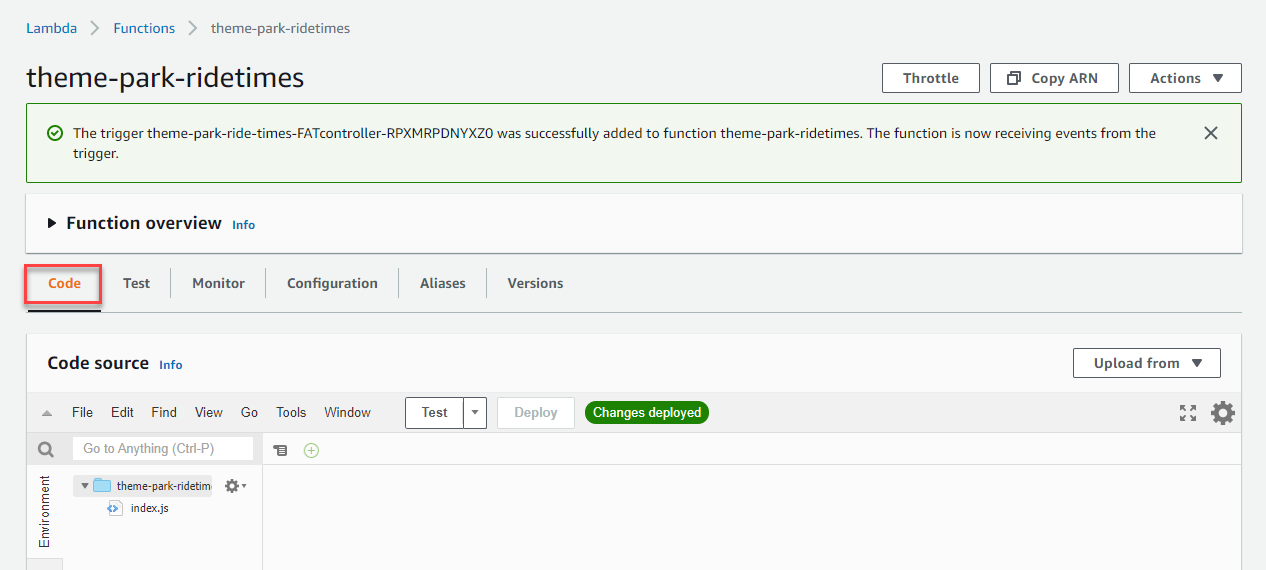
**Now it’s your time to finish the codes. **
This Lambda function code should read the latest message from the SNS topic, writes it to the DynamoDB table, and then pushes the message to the frontend application via an IoT topic.
You could change the code runtime from NodeJS to python or other code language you are familiar with, by changing Runtime settings under the Code Tab.
The environment variables could be found below.
Adding environment variables
This function uses three environment variables:
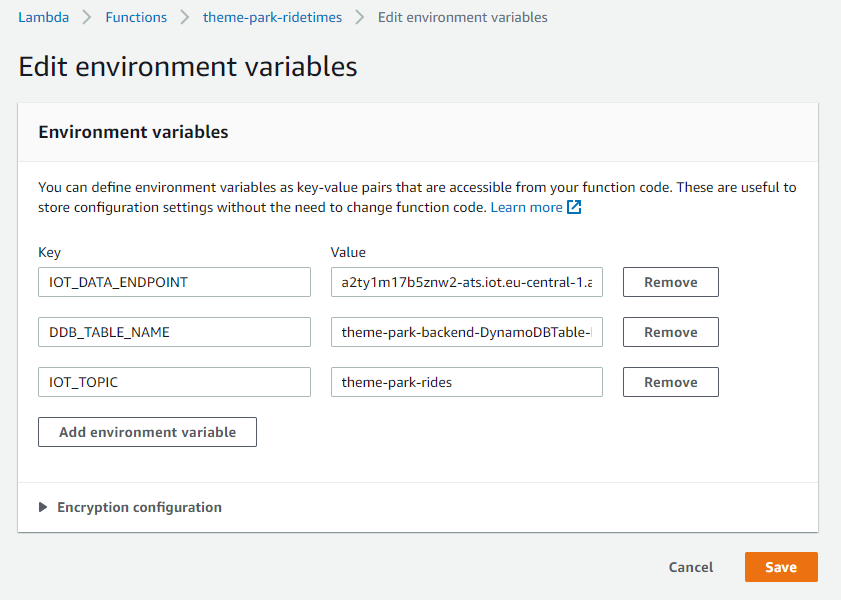
IOT_DATA_ENDPOINT: the IoT endpoint hostname.IOT_TOPIC: The name of the IoT topic to publish messages to, which istheme-park-rides.DDB_TABLE_NAME: The name of the application’s DynamoDB table.
In this section, you will retrieve and configure these Environment Variables for the function.
Step-by-step instructions
-
Go back to your browser tab with Cloud9 running. If you need to re-launch Cloud9, from the AWS Management Console, select Services then select Cloud9 under Developer Tools. Make sure your region is correct.
-
In the terminal enter the following command to retrieve the value for IOT_DATA_ENDPOINT:
aws iot describe-endpoint --endpoint-type iot:Data-ATS
- Next, enter the following command to retrieve the value for DDB_TABLE_NAME:
aws dynamodb list-tables | grep backend

- Go back to the browser tab with the
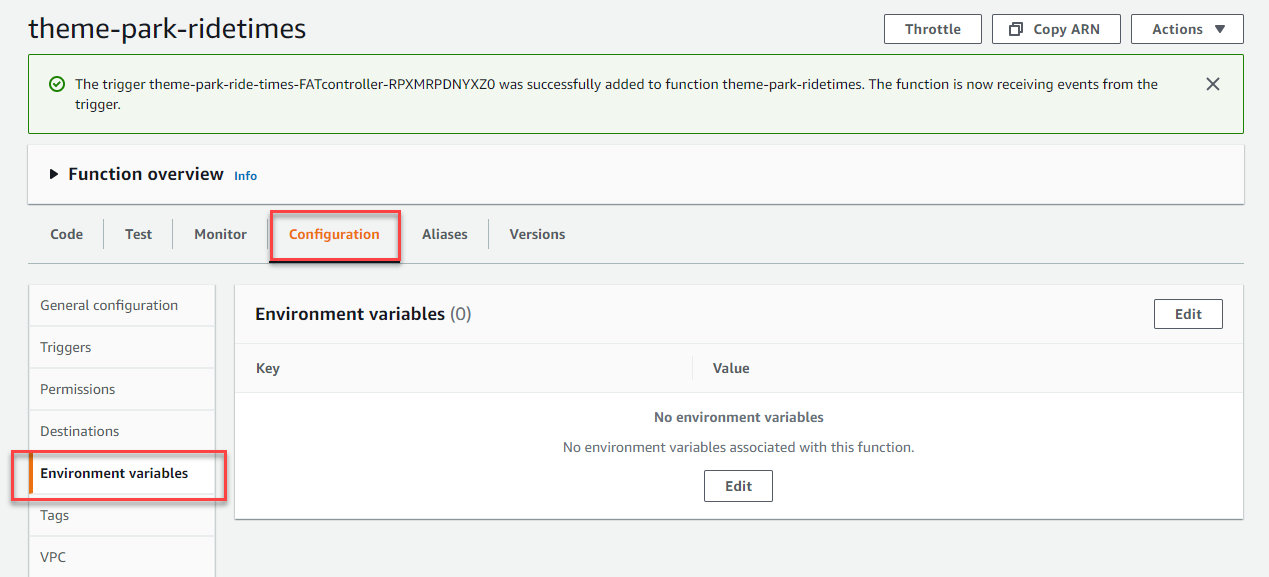
theme-park-ridetimesLambda function open. Choose the Configuration tab, then select the Environment variables menu option on the left.
-
In the Environment variables card, choose Edit.
-
Choose Add environment variable three times to enter the three environment variables, as follows:
- IOT_DATA_ENDPOINT - the value from step 2 above (without quotes).
- DDB_TABLE_NAME - the value from step 3 above (without quotes).
- IOT_TOPIC -
theme-park-rides
- Choose Save.
Ensure you have entered the environment variables into the Environment variables card, not the Tags card.