Backend
Overview
Park guests love taking photos on the rides and attractions. This app feature will let guests take a selfie and see a composited picture in the application. From here, they can publish their masterpiece on social media.
How it works
- The front-end calls an API endpoint to get a presigned URL to upload the photo to S3. This enables the front-end application to upload directly to S3 without a webserver. This results in a new JPG object in the S3 Upload bucket.
- When a new object is written to the Upload bucket, this invokes the first Lambda function in the sequence, which uses a process called Chromakey to remove the green screen background from the image. The resulting image is written to the Processing bucket.
- When a new object is written to the Processing bucket, this invokes the next Lambda function which composites the image with a new background and theme park logo. This resulting image is written into the Final bucket.
- Lastly, when a new object is written to the Final bucket, this invokes the final Lambda function which sends a notification to IoT core that the file is ready. This notifies the front-end application via the IoT topic notifications.
The Serverless Backend
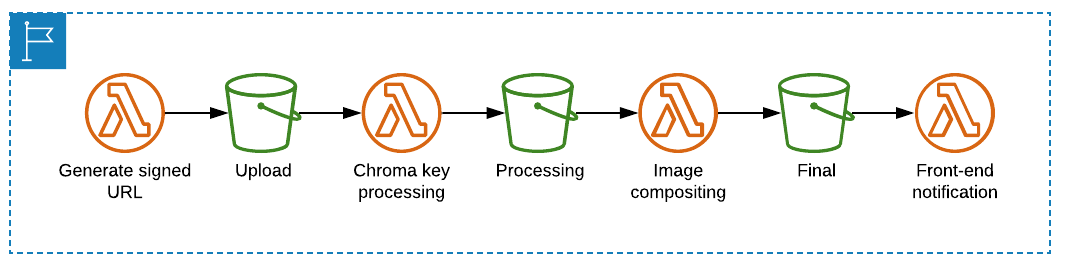
- The image is uploaded by the front-end into the Upload Bucket.
- A chromakey process removes the background and saves the object into the Processing Bucket.
- A compositing process creates a final image that is saved into the Final Bucket.
- A message is sent to IoT Core to notify the front-end that the file is now ready.
In this module, you will deploy three Lambda functions. Once set up, you will update the front-end code to enable the upload process.
Once configured, you will:
- Test the backend using a sample image to ensure the flow is working as expected.
- Test the frontend by taking a selfie against the green screens in the workshop room, and Tweet it to the world!
Set up environment variables
Run the following commands in the Cloud9 terminal to set environment variables used in this workshop:
AWS_REGION=$(curl -s http://169.254.169.254/latest/meta-data/placement/availability-zone | sed 's/\(.*\)[a-z]/\1/')
FINAL_BUCKET=$(aws cloudformation describe-stack-resource --stack-name theme-park-backend --logical-resource-id FinalBucket --query "StackResourceDetail.PhysicalResourceId" --output text)
UPLOAD_BUCKET=$(aws cloudformation describe-stack-resource --stack-name theme-park-backend --logical-resource-id UploadBucket --query "StackResourceDetail.PhysicalResourceId" --output text)
accountId=$(curl -s http://169.254.169.254/latest/dynamic/instance-identity/document | jq -r .accountId)
s3_deploy_bucket="theme-park-sam-deploys-${accountId}"
Environment variables are not stored in the terminal. Any time you close Cloud9 or open a new terminal, you will need to rerun these commands to set environment variables. This section is provided in each module.
Deploy the infrastructure
There are three parts to this module:
- Creating the chromakey Lambda function
- Creating the compositing Lambda function
- Creating the post-processing notification Lambda function
To start the first section, click here to continue.